
Growing Pains
Plus: Ongoing mayoral hypocrisy, and a chance to be part of an academic study on housing!

Thank you for reading our Thursday newsletter! If you want to support more housing advocacy in Calgary, don’t forget to:
Share this newsletter
Subscribe, if you haven’t already
Make a small donation to info@moreneighbourscalgary.ca
Thank you!
Be Part of Housing Research!
Prof. Jason Hawkins at the University of Calgary is currently recruiting participants for a research focus group on housing and neighbourhood preferences. Their research team is looking for participants.
The session will involve discussion of different residential and neighbourhood scenarios, including reactions to sample images and urban design features. Feedback from participants will help inform the development of a larger research survey.
Duration: Approximately 45 minutes
Participation options: In person (Calgary) or online
If you are interested in participating, please register using the links below:
https://calendly.com/jfhawkin/housing-focus-group-eng (main campus - ENF 227)
https://calendly.com/jfhawkin/housing-focus-group-sapl (SAPL - TBD)
https://calendly.com/jfhawkin/housing-focus-group-online (online)
If you have any questions, please feel free to contact Azin Dinarvand (azin.dinarvand@ucalgary.ca) or Jason Hawkins (jfhawkin@ucalgary.ca).
When Actions Speak Louder Than Words
Mayor Farkas was quoted in the Herald on May 5, presenting himself as laser-focused on moving towards zoning changes via local area plans:
“Given that we live in a post-blanket rezoning world, if we’re not going to go with a blanket approach, we need to work more thoughtfully and tactically with the communities that are most positioned to be benefited or challenged by increased density… My perfect world is to have these local area plans in place but, as quickly as possible following the approval of these plans, actually implementing the zoning to match that.”
~Mayor Jeromy Farkas in the Calgary Herald on May 5. Emphasis added.
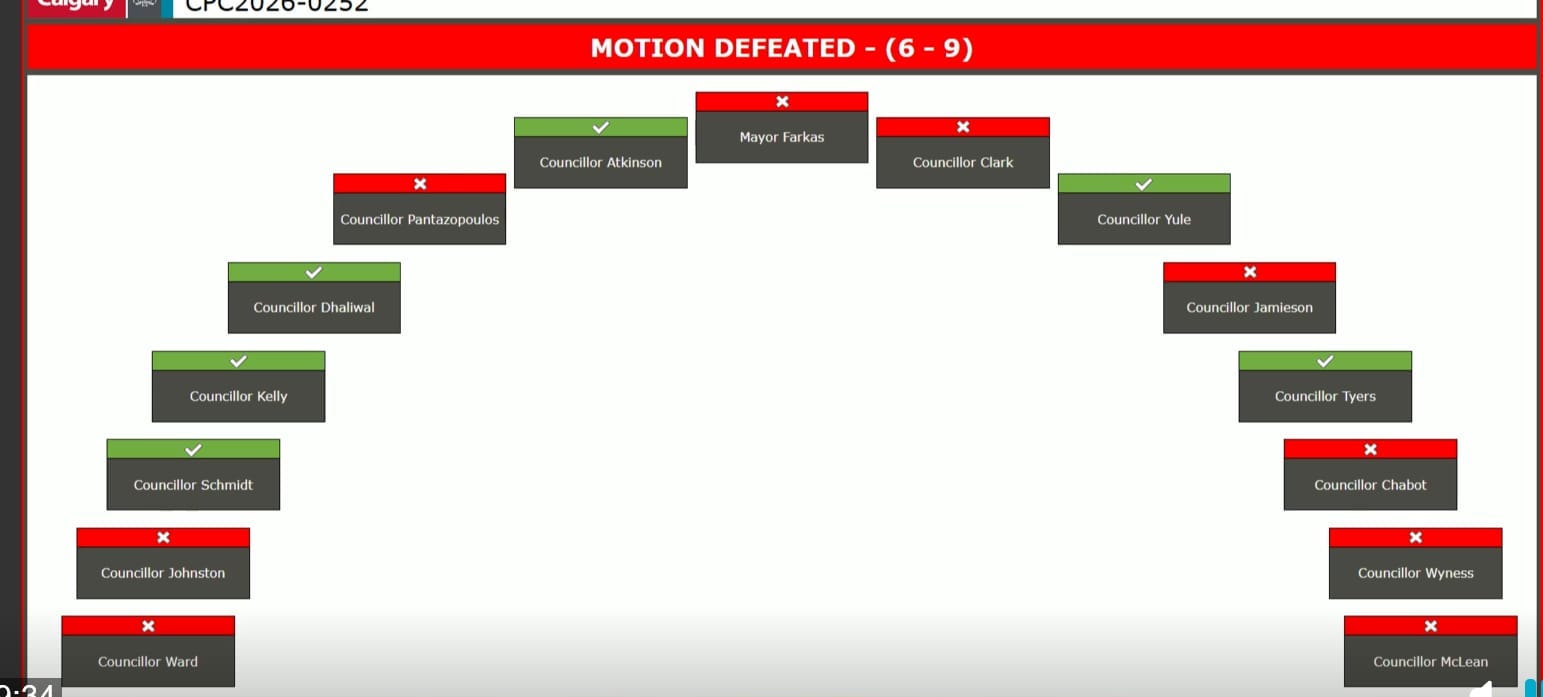
And yet, on May 12, just one week apart, Mayor Farkas voted against a H-GO rezoning for a development that matched directly with the Local Area Plan.
Growing Pains
By Spencer Andreasen
As a father of four young children, I have some experience with the discomfort that accompanies development. My house never has enough space; the mountain of laundry my wife and I fold every week only seems to get bigger. Occasionally one of our kids will wake us up in the night with sore legs or feet. Why? Growing Pains – our bones and muscles grow at different rates, straining against one another. It’s not pleasant, but it’s part of development.
Cities are a lot like people. They grow, sometimes slowly, sometimes more quickly. If Calgary were a person, it would be an adolescent – going through a growth spurt, currently experiencing growing pains. The skeleton and sinew that structures the city – roads, highways, water mains, power grids –– grow in parallel, but not always in synchronicity, with the softer tissue of communities, parks, civic structures… and housing.
As Calgary experiences a growth spurt, and the growing pains that come along with it, the simple reality is: we need more places for people to live. ‘Blanket rezoning’, recently repealed by City Council, was one way of attempting to address housing availability and affordability in Calgary. At a macro scale, greater density within the developed areas of the City would inevitably lead to a reduction in housing prices, and the increased housing stock would alleviate rental costs. Despite these benefits, some Calgarians had concerns about the new zoning, especially the scale of rowhouse development that it enabled. The question now is: how do we build the housing that we need while addressing Calgarians’ concerns?
As an architect and contractor I have the opportunity to work daily to relieve these growing pains, providing homeowners with thoughtful and considerate developments that improve their communities as they grow. My company, Haven Works, focuses on delivering alternative housing, like Backyard suites and secondary suites, which are without question the most subtle and unintrusive way of increasing density in Calgary’s developed area. If blanket rezoning is seen by some as too drastic a solution, Backyard suites are the non-intrusive antidote.
Resistance to new housing is not typically about whether more housing is needed. This is, I think, widely acknowledged by most Calgarians. Rather, the resistance is often a reaction to what neighbours perceive to be a developer-oriented process with very few opportunities to influence outcomes that affect them. While not yet as popular in Calgary as in other larger cities, Backyard suites were already a legitimate and growing means of increasing density even before blanket rezoning was introduced in 2024. They were listed in the pre-2024 bylaw as an allowable use in even the most restrictive low-density residential zone, R-C1.
Even after blanket rezoning is repealed, Backyard suites will almost certainly be allowed in most low-density residential zones under the next version of the bylaw. Because they are limited in scale and parcel coverage, they are intended to fit into the existing low-density context of urban development, and can be found in many communities throughout the city, with more being built every year.
But more can be done. Despite their merits, there are only about four hundred backyard suites in Calgary. Hypothetically, the developed area could double its number of households with minimal increase in parcel coverage by incentivizing the construction of backyard and secondary suites. In recognition of this, a new incentive program has recently been introduced by The City of Calgary to boost the number of backyard suites in the City. The program provides financial offsets for general construction costs and utility connections, as well as additional incentives for projects designed for people with mobility issues.
Now that the blanket rezoning has been repealed, policymakers must do the hard work of introducing meaningful amendments to the previous bylaw, with hearings and strategy sessions planned for this summer. Simple changes will make building backyard suites significantly more appealing. Shifting the bylaw away from using maximum floor areas towards using maximum building coverages would allow multi-level living spaces without increasing parcel coverage. This means more flexibility in design and configuration, unlocking new possibilities for many non-standard or irregularly shaped parcels. Similarly, including floor area increases for backyard suites as an incentive when designed for accessibility would appeal to the increasing number of people hoping to avoid overcrowded nursing homes by aging in place.
Even with these small changes, backyard suites provide a more gentle solution to the housing crisis. Where a new rowhouse can feel overwhelming to immediate neighbours, backyard suites are refreshingly modest in scale. Most properties in existing residential communities already have a single or double-car garage. A backyard suite simply sits on top. They take up no additional parking space, and preserve backyard amenity space for the parcel they are built on, while maintaining valuable access to sunlight for immediate neighbours. Moreover, Backyard suites are built for a variety of different circumstances, capable of addressing a diverse range of needs. They are nearly always built by current home-owners who know their neighbours and want to retain good relationships. They are empty-nesters approaching retirement and looking to downsize. They are 20 and 30 somethings hoping to start a family but wanting to have grandparents nearby. They are home gardeners who can’t imagine moving away from the backyard they have tended to for decades. People build Backyard suites for a variety of reasons – resale for profit is rarely one of them. Because of this, Backyard suites represent a very appealing option for owner-Developers and neighbors alike.
Backyard suites also provide community benefits by generating passive and active surveillance to laneways and alleyways, areas often relegated to neglect and undesirable activities. By giving properties two unique front facades, they activate alleys with more regular vehicular and pedestrian access. They also provide overlooking windows, reducing the need for surveillance systems and preventing vandalism. So too, in communities with extensive laneways, Backyard suites can catalyze entire networks of dormant alleys and pathways with latent potential for improving livability and desirability.
Calgary needs more housing, to be sure. In the mid-1980s, when I was born here, the population was barely more than 600,000 people. Since then, the population has more than doubled and is expected to grow to more than 2 million people over the next decade or so.
This growth hasn’t always been pleasant (or pretty), but growing pains are part of building a great city. This growth requires more housing and more types of housing. Backyard suites are a subtle solution to many of the issues raised on both sides of the debate about Calgary’s growing pains. They can fit nearly anywhere. They’re typically built by homeowners – not speculators. They have minimal negative impact on neighbours and provide long-lasting positive influence on communities. As Calgary grows, prudent and practical housing typologies like Backyard suites will no doubt support a brighter future both for residents and communities.
Spencer Andreasen is an architect and contractor who builds backyard suites at his company, Haven Works. More Neighbours welcomes his perspective on this housing type and encourages interest as Calgary City Council develops a real replacement plan for blanket rezoning.
You can reach Spencer at spencer@havenworks.ca to learn about his business.
Spencer Andreasen is an architect and contractor who builds backyard suites at his company, Haven Works. More Neighbours welcomes his perspective on this housing type and encourages interest as Calgary City Council develops a real replacement plan for blanket rezoning. You can reach Spencer at spencer@havenworks.ca to learn about his business.